

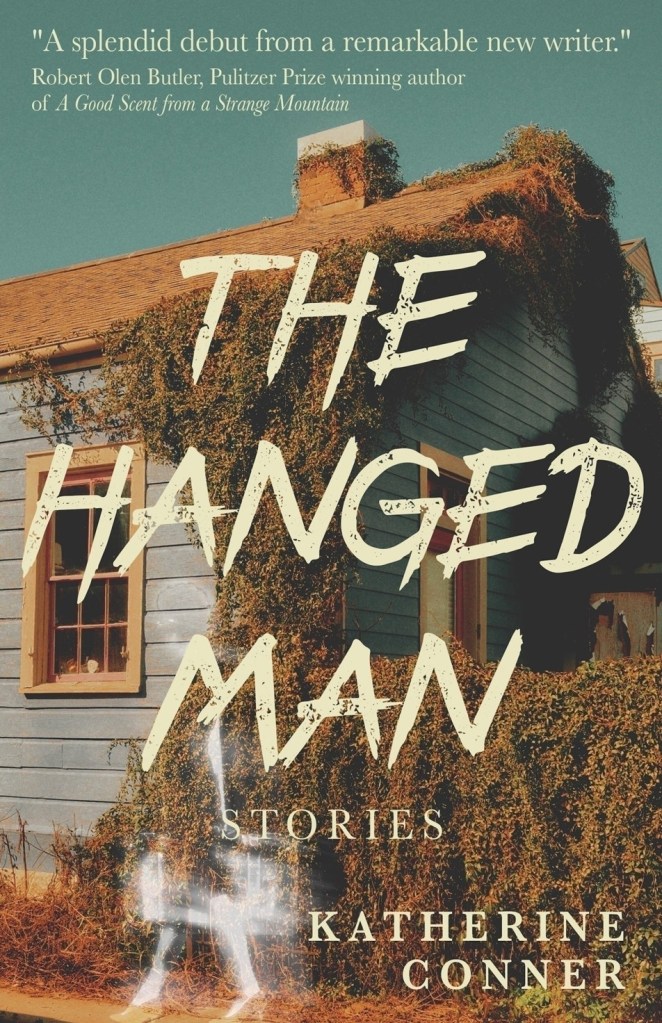
The disappearance of a loved one is often a sudden, unexpected event, but surviving the disappearance can be a slow, agonizing process, an erasure of oneself as well as the vanished. Katherine Conner’s The Hanged Man, a collection of short stories, depicts the collateral damage of abandonment in vivid, pain-evoking detail, in which the survivors exist in a state of suspension, their lives permanently altered by the vanishing of a mother or a lover.
Six of the eight stories in The Hanged Man are linked to the disappearance of Nadine, a Lebanese American woman who abruptly walked out on her three daughters, Louise, Georgia, and Virginia, each of whom is left to grow up coping with her absence. Their abandonment leaves them not only with the inevitable question of “why?” but also with something even more disturbing and overpowering: the nagging possibility of her return and, with it, the inability to accept that anything is permanent or real. In “Percipient,” Georgia, the youngest sister who gives ghost tours in the French Quarter of New Orleans, sees a man whom she believes is the same ghost who haunted her room as a child. In “Neshoba,” Virginia, the middle sister, works as a typist for a morally ambiguous transient named Cal, dutifully transcribing the bizarre, fabricated stories of his past. After being fired from her former job as a receptionist at a psychiatric hospital, where a woman who looked exactly like her missing mother came in to commit herself, she holds her mother responsible for the instability in her life. “How easy it is to blame the absent, the vanished,” she reflects.
In “Mummy Baby,” Virginia recalls a story of her mother’s great-aunt who carried a dead fetus in her womb for thirty years until she passed, lamenting that the fetus, supposedly displayed in a museum in Biloxi, wasn’t buried with its mother, mirroring her own separation from Nadine and the resulting sense of loss. “She runs her fingers down her arm and feels it even now, this hollowness . . . there’s something missing, too much room. A clean, echoing emptiness . . .” In “Relay Operator,” Louise, the oldest sister, is unable to shake the memory of a mysterious midnight phone call she facilitated with a woman whose voice resembles her mother’s. “Her voice is faster now, nervous, and Louise can’t help but imagine her with black eyes slit ascents, the phone wedged between her shoulder and ear, hands knotted together and her fingernails pressing crescent moons into her palms . . . [s]cared all the way down to the tips of her fingers.”
“Double Walker” shifts the collection’s narrative to Cal’s perspective, revealing his own history of abandonment and an obsession with an older woman who left him. His lies become a means of controlling his fate. “It’s the story that’s the thing to Cal. The story itself, more real than the truth, and as he tells a story about himself, his past, it doesn’t matter if it really happened or not. As soon as he says it happened, it did.” In “The High Priestess,” we learn how Nadine has lived off strangers since she abandoned her daughters six years ago, as she attends a wedding with a man she barely knows, still plagued by the constant numbness that made her unable to feel the touch of her own children.
Rather than treating these episodes as plot points of a mystery to be solved, the stories create a psychological limbo that distorts identity and blurs the lines between reality and the imagined. Conner deftly explores how abandonment hollows a person out, leaving a fragile shell, desperate to find any sign or ritual that proves they still exist and matter. Georgia’s fruitless pursuit of a childhood ghost is an attempt to prove that the disappeared can eventually be found. Virginia’s willingness to become the scribe of Cal’s lies and her pursuit of a mythical dead baby are desperate attempts to prove that what is unlikely can perhaps still be true. Louise dismisses Virginia’s sighting of their mother at the hospital but revisits the relay call, insisting that she has at last found Nadine. Cal’s constant “double walking,” alternating between the real and a fabricated, allows him to hope for an alternate reality in which what he has not found in one life could still be discovered in another.
The after-effects of Nadine’s abandonment of her children are mirrored in two standalone stories in the collection, each of which deals with a missing sixteen-year-old girl. In “Snake’s Tongue,” a woman named Iris discovers a series of stray objects at the fork of a river, including a pink tank top in which the missing girl was last seen, prompting her to suspect her father’s involvement in her disappearance. In “The Hanged Man,” a fortune teller named Roman copes with the inescapable guilt he feels over swindling people experiencing loss, including the father of another missing teenager, a skill set he learned from his deceased Mary Kay Cosmetics-selling mother. Like Cal’s fabrications, Roman gives his clients “a sense, however tenuous and unreal, that they’re in control — of their appearance, their future. Their existence.”
Conner’s masterful storytelling incorporates strong, memorable imagery. Georgia’s recollection of her mother’s unhappiness is captured by how she would sit for hours picking dead skin from her cuticles. Tarot card readings are used to show the characters’ desperation for incomplete answers. The cards serve as symbols for the characters’ internal states: The Hanged Man card represents a state of suspension and waiting, becoming a “willing victim,” while The High Priestess card represents hidden secrets and repressed memories. The scent of Cal’s honeysuckle lotion connects the sisters to the backyard of their childhood home and Cal to his past. As Nadine stares at a statue of an undine, a nymph with no soul, in a fountain at the wedding, she is forced to confront the same incompleteness felt by those she left behind.
The Hanged Man ties together the themes of abandonment, the loss of a parent, fractious relationships, and hauntings. It illustrates the lies and fables we construct around what we cannot understand, the overwhelming regret of not having understood those once close to us, and the realization that, despite hopefulness, time may have run out.
FICTION
The Hanged Man
By Katherine Conner
Black Lawrence Press
Published August 6, 2026


